As AI and high-performance computing continue to push chip-to-chip interconnects toward higher density and higher speed, through-glass vias (TGVs) are receiving growing attention in advanced packaging. As via diameters shrink and aspect ratios increase, however, copper metallization becomes increasingly difficult. One of the main challenges is achieving continuous seed coverage and uniform copper deposition through the full depth of the via without premature closure, trapped voids, or excessive internal stress.
Related reading: Guide to TGV ManufacturingMicrovia Metal FillingGlass-Based Packaging Technology
Why Copper Via Filling Is So Difficult
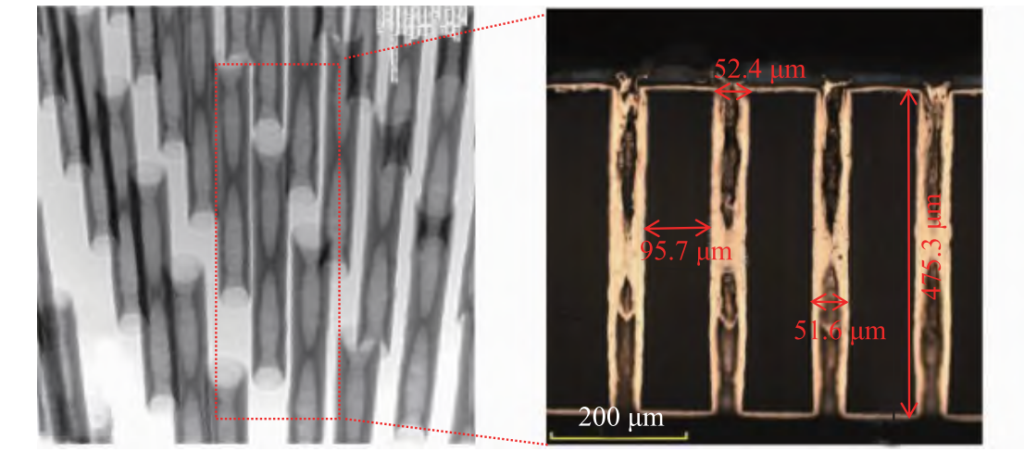
The first challenge appears before electroplating even begins. Glass is electrically insulating, so a continuous conductive seed layer must first be established along the via sidewalls. Depending on the via geometry and aspect ratio, this may involve PVD, electroless deposition, or a combination of metallization processes.
Maintaining continuous seed coverage inside a deep, narrow via is difficult because deposition becomes less uniform as line-of-sight access and transport into the via decrease. If the conductive layer becomes too thin or discontinuous in the deeper regions of the via, subsequent electroplating may become nonuniform or fail locally.
Once electroplating begins, another problem emerges: mass transport and current distribution are not uniform throughout a high-aspect-ratio through via. Copper ions and organic additives do not reach every region of the via at the same rate, and deposition can proceed more rapidly near the via openings than in the deeper interior.
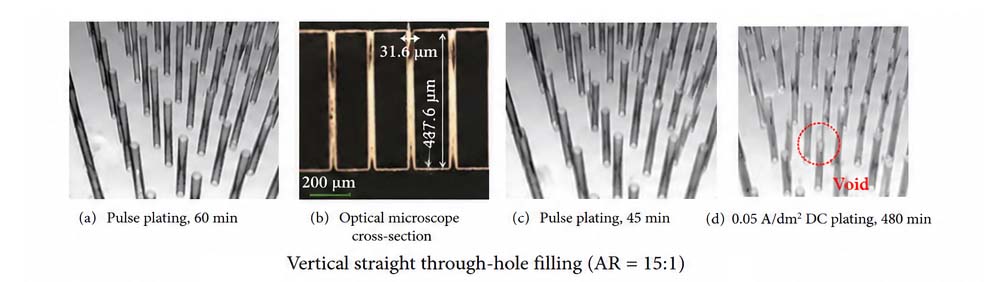
If this imbalance is not controlled, copper growth from the two openings can narrow the entrance regions or bridge prematurely, leaving an enclosed void inside the via.
To prevent this, the electroplating process must promote superconformal deposition rather than simple conformal growth. Depending on the bath chemistry, this can involve suppressors, accelerators, levelers, or specialized additive systems that modify local deposition rates across different regions of the via.
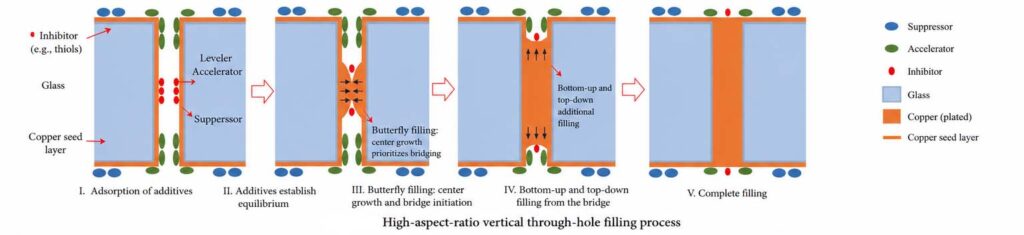
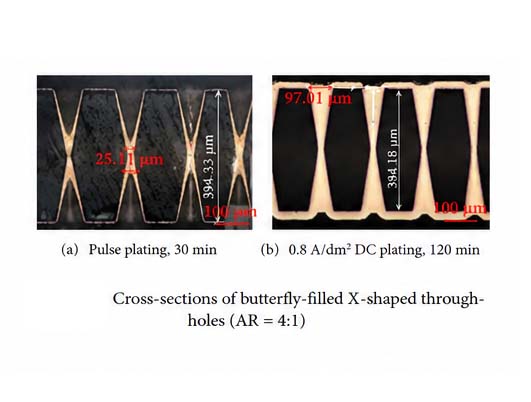
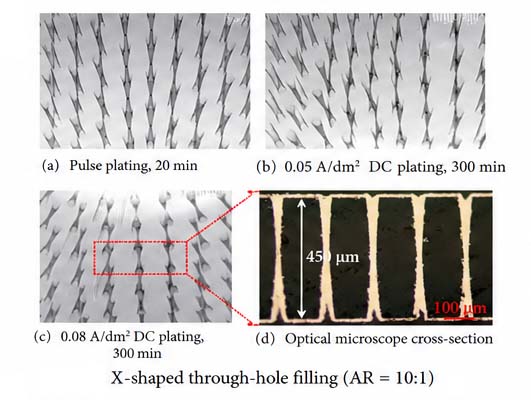
Through-glass vias also differ from blind vias in an important way: there is not necessarily a single “bottom” from which copper must grow upward. In many through-via filling schemes, faster deposition develops in the central region of the via, creating a butterfly-like growth profile that eventually forms a bridge. Subsequent deposition can then fill the remaining cavities from the newly formed internal surfaces.
Approaches to Void-Free TGV Filling
Several filling strategies have been investigated to control where copper deposits first and how the remaining volume closes.
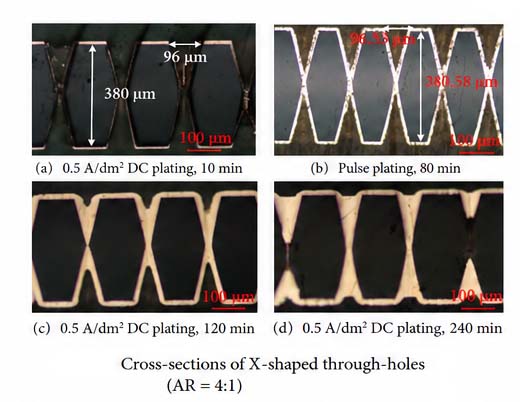
One approach uses the via geometry itself. Tapered, hourglass, or X-shaped vias can concentrate deposition near a narrower central region, making it easier for copper to bridge internally before the openings close. This can reduce the risk of trapped voids, although the effectiveness depends strongly on via profile and plating conditions.
Another approach relies on additive-controlled electroplating. Organic additives can selectively suppress or accelerate copper deposition in different regions of the via, producing a superconformal growth profile rather than uniform sidewall deposition.
Published studies have demonstrated void-free or near-void-free filling of relatively high-aspect-ratio glass vias using carefully controlled additive chemistries. More recent research has pushed fully copper-filled TGVs to substantially higher aspect ratios, although these results depend strongly on via geometry, seed-layer continuity, plating chemistry, and the overall metallization sequence.
Pulse and pulse-reverse electroplating provide another way to control deposition behavior. Instead of applying a constant direct current, the process alternates the current waveform so that deposition and partial dissolution occur periodically.
The reverse portion of the waveform can preferentially remove copper from regions with higher local current density, particularly near the via openings, while allowing copper to continue building in less accessible regions. When combined with appropriate bath chemistry and additive adsorption behavior, this can reduce premature closure and improve filling uniformity.
However, pulse-reverse plating is not a universal solution. Its effectiveness depends on forward and reverse current density, pulse duration, duty cycle, via geometry, seed-layer quality, solution transport, and additive chemistry. These variables must be optimized together rather than independently.
Thermal and Mechanical Reliability Also Matter
Achieving a void-free copper fill is only part of the problem.
Copper generally has a higher coefficient of thermal expansion than the glass materials used for TGV substrates, although the magnitude of the mismatch depends on the specific glass composition. During later thermal processing or device operation, this mismatch can generate stress at the copper-glass interface.
As a result, copper microstructure, residual stress, interfacial adhesion, via geometry, and subsequent thermal treatment all become important reliability factors. A filling process that produces a visually complete copper via may still be unsuitable if it generates excessive stress, interfacial separation, or cracking during thermal cycling.
What Limits Higher-Aspect-Ratio TGV Filling?
As TGV dimensions continue to scale, the challenge is not simply to deposit more copper into a smaller hole.
Several problems become more severe at the same time:
- maintaining continuous seed coverage through the entire via;
- transporting copper ions and additives into the via interior;
- controlling deposition rates at the two openings and the central region;
- preventing premature bridging or trapped voids;
- limiting copper residual stress;
- maintaining adhesion between copper and glass;
- and integrating the filled via with later planarization, redistribution-layer, and packaging processes.
This is why reported high-aspect-ratio TGV results should be interpreted carefully. A successful laboratory demonstration does not automatically represent a stable high-volume manufacturing process. Via geometry, glass composition, metallization sequence, plating bath chemistry, equipment configuration, and process window all affect whether the same result can be reproduced reliably at production scale.
Void-free copper filling therefore remains an important process-development area for high-density TGV interconnects. Continued improvements in via formation, seed-layer engineering, electroplating chemistry, waveform control, and thermomechanical reliability will all be needed as TGV dimensions move toward smaller diameters and higher aspect ratios.